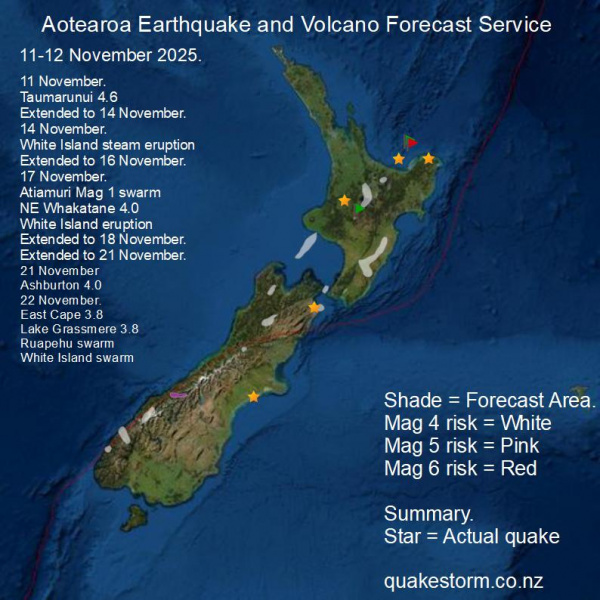
Aotearoa Summary. 11 November 2025 - 4 December 2025
Quakes never came though and the period turned volcanic later on, following the simple forecast rule that eruptions tend to follow quakes during any period. The volcanic period was also signalled in New Zealand with quake swarms at White Island and Ruapehu, minor ash at White Island and Mag 4.0 at Whakatane. Ironically, despite its strength, the 12 November Kp8 aurora was short lived and added to the evidence that during Solar Cycle 25, Earth's weakening magnetic field is failing to shield what are some fairly innocuous solar storms. Geonet later reported that White Island was in near constant eruption. Air New Zealand cancelled flights at Tauranga on several days due to ash emissions. Mag 1 quakes swarmed around Ruapehu at Hauhangatahi and Rangipo. Volcanic tremor in the 2-7 Hz band remained strong at Ruapehu on SSAM. A small cluster of quakes came soon after the last update on 21 November with good location success at Lake Grassmere. Ashburton 4.0 was in an unusual location and the East Cape 3.8 was linked to the active Kermadec Ridge. Rarotonga SSAM shows intermittent weak volcanic activity since 1 October. Global weather was impacted by the 12 November Kp8 aurora. Giant hailstones in Canterbury and the worst monsoon in Southeast Asia in living memory and many other storys. Thousands have drowned and millions homeless in Bangladesh, Sumatra, Thailand, Vietnam, Malaysia. New active southern sunspots are here on 5 December, replacing northern sunspot AR4274 from the last rotation. 17 November. Atiamuri Mag 1 swarm 2.52am 30km NE Whakatane 4.0 4.16am Eruption White Island 10.53am 21 November. 25km East of Ashburton 4.0 7.50pm 22 November. East Cape 3.8 1.58pm Lake Grassmere 3.8 6.23pm Update. 20 November 11.30pm Local and Pacific quakes are quiet as the period turns strongly volcanic. Locally, White Island remains hot with near continuous low level eruption. Haast forecast hotspot remains active at low magnitude. Solar wind fell to background levels when quakes are more likely on 20 November, 3 days later than forecasted. Magnetic orientation has been weak through most of the period, excluding the initial Kp8 geomagnetic storm on 12 November. New spaceweather from an uncertain source has arrived tonight. The forecast period is extended to 21 November. All risk locations are unchanged from 11 November. Haast remains Mag 5 risk. Update. 17 November 11.30pm Mag 4 quakes remain sparse through the period. Quakes have been busy in Haast and Otira risk locations but at low magnitude. A busy volcanic period has evolved on the Volcanic Plateau along with a wider Pacific volcanic period. An Atiamuri Mag 1 quake swarm beginning 2.52am, lasting an hour was soon followed by the 4.16am 30km NE of Whakatane 4.0 which was followed in turn by the 10.53am White Island eruption. Ruapehu remains quiet. A very small quake swarm has arguably evolved at Hauhungatahi. Spaceweather remains unsettled with a minor coronal mass ejection shock lifting solar wind speed back up to over 500km/second, extending the period. New solar wind is due about now from Coronal Hole 1330 and will extend the period more. Very long periods typically produce strong tectonic responses at the end of the period when solar wind speed drops back to background levels, 400km/second. The forecast period is extended to 18 November and likely to be further extended. Fiordland and Haast quakes may pick up on 18 November. Haast remains Mag 5 risk. 17 November. Atiamuri Mag 1 swarm 2.52am 30km NE Whakatane 4.0 4.16am Eruption White Island 10.53am Update. 14 November 9.30pm Pacific quakes and eruptions are eerily quiet as the typically active end of the period approaches. Solar Cycle 25 has once again shown how even big coronal mass ejections just don't seem to bring any tectonic action at the onset of geomagnetic storming. This is in stark contrast to Solar Cycle 24 where a big quake would often turn within minutes of geomagnetic storms commencing. The series of coronal mass ejections from sunspot AR4274 have all passed now with the last shock from the biggest X5 flare turning out to be a real fizzer. The likely explanation is that the earlier coronal mass ejections swept up all the free protons and electrons in space, leaving behind a vacuum. There were simply no extra protons which the final X5 solar shock could sweep up and it therfore had no punch. Solar wind parameters were unspectacular in most ways. Particle density peaked at 50 particles/cm3. Solar wind speed got to 1000km/second which is high but not extreme. The major difference was once again the massive -55nanoTesla magnetic flux density, indicating how Earth's weakening magnetic field in Solar Cycle 25 doesn't act as such a good solar storm shield anymore. Solar wind, presently 600km/second probably needs to drop back to 400km/second before quakes or eruptions occur. 15 November may therefore be a quiet day for quakes. Quakes may pick up on 16 November when solar wind speed is 400km/second. Local volcanologists confirmed a decent steam eruption at White Island on 14 November. Background volcanic tremor at Ruapehu remains steady with no sign of any quake swarm or degassing. 14 November. White Island steam eruption 11.40am Update. 13 November 2.30pm Pacific and local quakes remain quiet today, despite a major Kp8 geomagnetic storm raging overhead. Magnetic orientation remained strongly negative for the first 12 hours, peaking at -55nTesla, after yesterdays solar shock then flipped positive until 12.00pm NZST today when it flipped negative again. Most spaceweather forecasters are saying the storm is over but we are holding out that the third and potentially biggest coronal mass ejection may not be here yet. Regardless, Bz magnetic flux density is -20nT as this post is made and quakes could suddenly start. The forecast period is extended to 14 November. Haast River, Lower Landsborough River location is increased to Mag 5 risk. Update. 12 November 12.30pm The first of three solar shock waves is arriving at ACE satellite. A very big X5.1 long duration flare and accompanying high proton storm has erupted from AR4274. The flare is closely following the X1.7 and X1.2 flares. Local quakes have unsurprisingly been very quiet on 11 November with no geomagnetic storms to power them. The forecast looked to 7pm on 11 November as the first solar shock arrival which has come 15 hours later than that. Cape Campbell, Northern Cook Strait are added to Mag 4 risk locations. The forecast period will be extended by several days. Local volcanologists announced that White Island is still in minor ash eruption. Forecast. 11-12 November 2025. Posted 11 November 1.15pm Magnitude 4 risk locations are Doubtful Sound, Northwest Arm Te Anau, Pyke River, Lower Landsborough River, Upper Haast River, Otira, Murchison, St Arnaud, South of St Arnaud, Mt Arthur, Castlepoint, Woodville, Dannevirke, Porangahau, Pongaroa, Waipukurau, Lake Taupo, Atiamuri, Tokoroa, Lake Tarawera. Possible minor ash eruption White Island. Possible minor quake swarm/degassing Ruapehu. Possibility Mag 5 New Zealand. Two significant Earth directed X1.7 and X1.2 flares from AR4274 are due to arrive soon. Kp9 geomagnetic storms possible dependent on magnetic orientation. The 11 November 7.51am 10km West of Taumarunui 4.6 was widely felt in the North Island and Upper South Island and occurred before this forecast was posted. The forecast period is likely to be extended. Aotearoa Earthquake and Volcano Forecast Service © 2013 - 2026 |