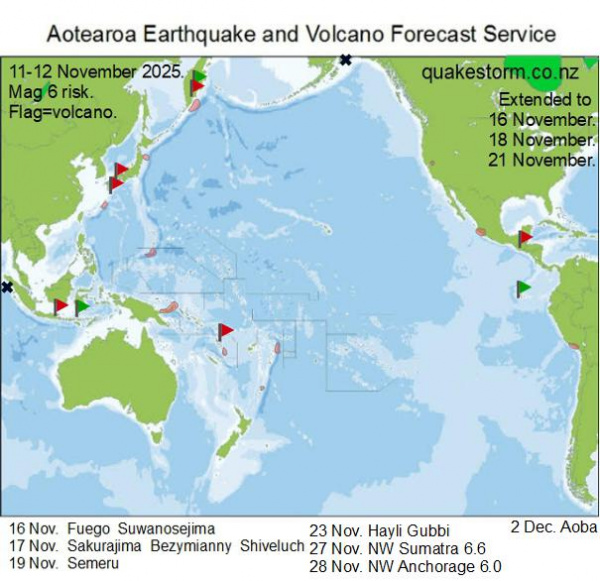
Pacific Summary 11 November 2025 - 4 December 2025
Quakes never came though and the period turned volcanic later on, following the simple forecast rule that eruptions tend to follow quakes during any period. The volcanic period was also signalled in New Zealand with quake swarms at White Island and Ruapehu, minor ash at White Island and Mag 4.0 at Whakatane. Ironically, despite its strength, the 12 November Kp8 aurora was short lived and added to the evidence that during Solar Cycle 25, Earth's weakening magnetic field is failing to shield what are some fairly innocuous solar storms. Many big eruptions occurred during the period. Semeru blew a big pyroclastic flow. Bezymianny blew twice during the period, the second eruption apparently bigger. Hayli Gubbi blew for the first time in 12 000 years according to local geologists. Hayli Gubbi is part of the large Erta Ale complex and 15 km from the Erta Ale lava pool. Mag 5.4, 5.5 quakes at Erta Ale on 24 November were precursor to the Hayli Gubbi eruption. The Aoba eruption was reported on 4 December but sometimes in the past eruptions tend not to be noticed for a few days as the volcano simmers along. A Mag 4.7 under Fernandina wasn't followed by any eruption although the volcano is likely to stay an eruption risk in a new forecast period. A new series of large active southern sunspots have replaced active northern sunspot AR4274 on the next solar rotation 4 December. Another big geomagnetic storm and volcanic period could unfold. 17 November. Eruption Sakurajima, Bezymianny, Shiveluch 19 November. Eruption Semeru 23 November. Eruption Hayli Gubbi, Bezymianny 27 November. Offshore Northwest Sumatra 6.6 5.56pm 28 November. 50km Northwest of Anchorage 6.0 6.11am 4 December. Aoba Update. 20 November 11.00pm Pacific quakes are quiet as the period turns strongly volcanic. A big pyroclastic eruption at Semeru has led to evcauations and fortunately no casualties. Sakurajima erupts regularly but according to Japanese volcanologists the 16 November eruption was significantly bigger than normal. Kamchatka volcanos are all active, unsurprisingly, considering the 30 July Kamchatka 8.8. No news from Galapagos Islands today although eruption news can take a while to filter through from this location. White Island is hot and in near continuous low level eruption. Solar wind conditions have been very tricky to forecast. Solar wind speed and density finally reached background levels when quakes become more likely on 20 November, 3 days later than forecasted. No sooner had quake conditions become favourable then magnetic orientation switched positive, leaving the Pacific bereft of quakes. New solar wind has arrived today from an uncertain source. Regardless, a strong volcanic period has evolved and may continue for a day or two yet. The forecast period is extended to 21 November. Mag 6 risk locations are unchanged since the start of the forecast period. 17 November. Eruption Sakurajima, Bezymianny, Shiveluch 19 November. Eruption Semeru Update. 17 November 11.00pm Pacific quakes remain quiet although a volcanic period seems to be evolving from 16 November. Solar wind remains stubbornly high with a small coronal mass ejection impact from another big X4 flare from AR4274 arriving on 16 November, reenergising and extending the period. Sunspot AR4274 has rotated to the west limb and the X4 flare was only slightly Earth directed. Solar wind may pick up again as a new coronal hole windstream arrives on 18 November. The period may be extended for several more days. The energy input from sunspot AR4274 over the period has been substantial without any tectonic release so a tectonic buildup is likely underway. A volcanic period may be unfolding. The forecast period is extended to 18 November. Colima is added to Mag 6 risk locations. La Cumbre is added to eruption risks. 16 November. Eruption Suwanosejima, Fuego. Update. 14 November 10.00p, Pacific quakes and eruptions are eerily quiet. A quake and eruption buildup may be underway. Solar wind speed, presently 600km/second, is likely to fall back to 400km/second by 16 November when a period of quakes and eruptions may occur. All risk locations and magnitudes are unchanged. Update. 12 November 5.00pm A strong but brief coronal mass ejection from the 9 November 0735UTC X1.7 flare arrived late morning. A substantial magnetic flux density of -55nT was recorded. Kp8 geomagnetic storming is underway. Conditions seem to be quickly easing ahead of a possibly bigger coronal mass ejection which could arrive anytime. The third coronal mass ejection from the 11 November X5.1 flare is likely faster moving than the earlier shocks. Pacific quakes and eruptions are quiet during the period so far. Bezymianny is added to eruption risks. The forecast period will be extended for several days. Forecast. 11-12 November 2025. Magnitude 6 risk locations are Raoul Island, Northern Tonga, Erromango, New Britain, Guam, Okinawa, East of Honshu, Offshore Kamchatka, Central California, Offshore Southern Peru. Volcanic activity may increase. Lewotobi. Possibility Mag 7 Pacific. East of Honshu higher risk. Confidence=low. The forecast is likely to be extended. Significant X1.7 and X1.2 flares with accompanying Earth directed coronal mass ejections from AR4274 are due soon. The second coronal mass ejection may be stronger than the first. Magnetic orientation is uncertain. Kp9 geomagnetic storms are possible. The 8-11 November East of Honshu 6.8, 6.4 +swarm may continue and possibly increase. Aotearoa Earthquake and Volcano Forecast Service © 2013 - 2026 |