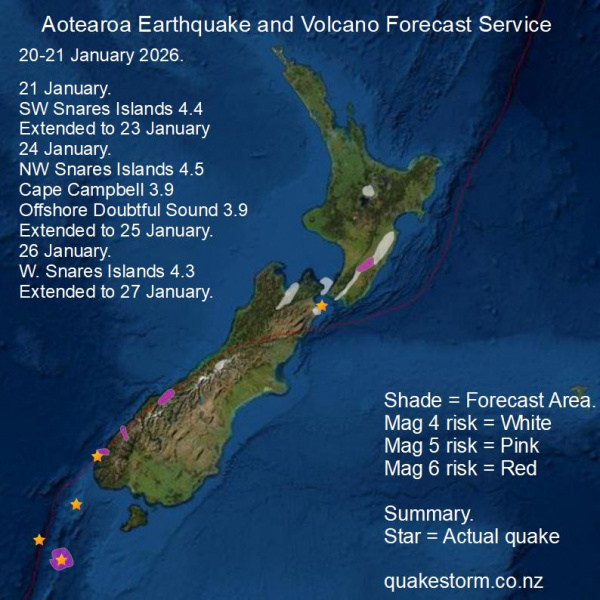
Aotearoa Summary. 20 January 2026 - 27 January 2026
Strong correlation between risk locations and quakes were evident as a strong Mag 5 quake swarm hit South of Fiordland. Excellent risk location correlation was also plain to see in Cook Strait/Kapiti both during the forecast period and also the following period in February. Additionally and importantly the South of Fiordland Mag 5 swarm and Cook Strait quakes showed very strong correlation in the following weeks after the forecast period had ended on 27 January. A major Mag 5 quake swarm has evolved over a wide area South of Fiordland and may evolve into Mag 6 during the next weeks as more spaceweather arrives and when quakes become more active during March-May aurora season. Weather systems rapidly intensify during geomagnetic storms and Mt Maunganui and East Cape deluges came on 22 January following several days of ionospheric storming.... 24 January. NW Snares Islands 4.5 1.07am North of Cape Campbell 3.9 12.46pm South of Doubtful Sound 3.9 2.49pm 26 January. West of Snares Islands 4.3 9.17am 27 January. North of Kapiti 4.6 1.53pm Update. 26 January 12.00pm Local quakes are getting busier with good risk location success but still low magnitude as spaceweather conditions remain elevated and unfavourable for quakes. Spaceweather is still elevated with an ongoing S1 solar radiation storm, solar wind speed still elevated at 500km/second and Kp4 geomagnetic conditions. Bz magnetic flux density is at -5nTesla, indicating electric charge is incoming and a tectonic buildup is underway. Quakes generally don't happen until solar wind falls back to 400km/second, indicating electric charge is outgoing and a piezoelectric tectonic discharge from Earth to space more likely, coming as quakes or eruptions. Angry sunspot 4341 is now no longer Earth facing and therefore the solar radiation storm is subsiding. Frustratingly, departing large southern coronal hole 1340 has complicated spaceweather and may be holding the wind speed above 400km/second. New spaceweather from equatorial coronal hole 1341 is due at Earth on 29 January and likely to increase solar wind speed again, extending the period even more if it hasn't dropped to background level before then. Fiordland remains Mag 5 risk as quakes rumble on west of the Snares Islands. Fiordland risk locations have been reduced to a smaller number of specific Mag 5 risk locations at Cascade River, Lower Arawhata River, South of Haast, Northwest Arm Te Anau, George Sound, Offshore Milford Sound, Doubtful Sound, South of Doubtful Sound. Doubtful Sound is higher risk. Good location success at Cape Campbell. The forecast period is extended to 27 January. 24 January. North of Cape Campbell 3.9 12.46pm South of Doubtful Sound 3.9 2.49pm 26 January. West of Snares Islands 4.3 9.17am 27 January. North of Kapiti 4.6 1.53pm Update. 22 January 3.00pm Local quakes are getting busier but still below Mag 4. Quakes are busy at Volcanic Plateau and South Wairarapa risk locations. Rarotonga SSAM graph shows a big seismic uptick, including possibly some minor undersea volcanic activity in Tonga and an indicator that the tectonic discharge phase is getting closer. Fiordland remains Mag 5 risk as the Snares quake sequence moves a little closer. Spaceweather remains in charge phase as the big solar storm continues. Indicators for continuing charge phase are a continuing S2 solar radiation storm from decaying sunspot 4341, solar wind levelling out at 500km/second and continuing Kp5/4 geomagnetic conditions. Energy is still coming in and the peak of the period is unlikely to come until energy starts to discharge. A tectonic discharge phase will only occur when the solar storm subsides completely and Earth then discharges back to space in order to rebalance. The forecast period is extended to 25 January. All risk locations and magnitudes are unchanged. 24 January. NW Snares Islands 4.5 1.07am Update. 22 January 3.00pm Local and Pacific quakes are quiet as the early part of the forecast period passes. The Kp8 geomagnetic storm featured very fast solar wind at 1100km/second and an accompanying S4 solar radiation storm and high energy protons. Magnetic flux density reached a staggering -50nTesla before fortunately switching positive where it stayed for the next day. Quakes faded away with the positive magnetic conditions. The evidence is clear that Earth's magnetic field is weakening and no longer acting as a good magnetic shield against solar storms. Magnetic conditions have switched south again as a quake buildup gets underway and quakes return. Solar wind speed was very high 1100km/seconds, providing a big energy input...the faster the protons move, the more energy they hold. Quakes and eruptions are likely to occur when the solar wind speed falls back to background levels of 400km/second. The piezoelectric energy building up under the ground will then be able to discharge back into space as Earth rebalances to the Sun's giant electric and magnetic fields. Magnitude 5 risk locations are West of Snares Islands, Fiordland, Pyke River, Cascade River, Lower Arawhata River, Haast, Pongaroa, Dannevirke, Eketahuna. Magnitude 4 risk locations are Upper Wilberforce River, Upper Rakaia River, Cape Campbell, St Arnaud, Nelson, West of Wellington, Turakirae Head, West of Masterton, Waipukurau, South of Hastings, Taupo, Tokoroa. Volcanos quiet. The forecasted strong solar storm has arrived early and with considerable force. Kp8 geomagnetic storming began at 8.00am NZST as very fast solar wind 1100km/seconds arrived. Magnetic Bz dropped out to -50nT at ACE satellite. The storm may not last long though if it is like other Solar Cycle 25 solar storms. Bz magnetic flux density has flipped to +50nT as this forecast is posted but will flip soon to negative and quake driving conditions. A severe G4 solar radiation storm with very high energy protons is underway. Aotearoa Earthquake and Volcano Forecast Service © 2013 - 2026 |