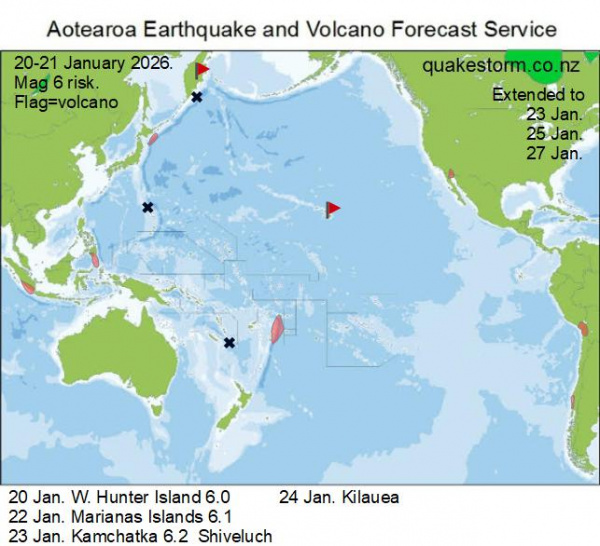
Pacific Summary. 20 January 2026 - 29 January 2026
Pacific quakes and eruptions showed little sign of major action in the end and the following period from 29 January to 3 March gave little evidence that a late piezoelectric/tectonic discharge occurred apart from the Chile 6.2 which was in a forecast location. Heavy quake activity occurred South of Fiji after the period had ended but only loosely in the Tonga risk location. The difficulty of forecasting was further highlighted by the New Zealand forecast showing strong correlation especially after the forecast period ended and a strong Mag 5 quake swarm which has lasted all of February and into March. 22 January. Northern Marianas Islands 6.1 5.37am 23 January. Kamchatka 6.2 1.42am Eruption Shiveluch 24 January. Eruption Kilauea 29 January. South Sandwich Islands 6.0 8.30pm Update. 26 January 2026. Pacific quakes are getting busier but only Mag 5. Spaceweather is still elevated with an ongoing S1 solar radiation storm and solar wind speed still elevated at 500km/second. Bz magnetic flux density is at -5nTesla, indicating electric charge is incoming and a tectonic buildup is underway. Quakes generally don't happen until solar wind falls back to 400km/second, indicating electric charge is outgoing and a piezoelectric tectonic discharge from Earth to space is more likely as quakes or eruptions. Angry sunspot 4341 is now no longer Earth facing and therefore the solar radiation storm is subsiding. Large southern coronal hole 1340 has complicated spaceweather and may be holding the wind speed above 400km/second. New spaceweather from equatorial coronal hole 1341 is due at Earth on 29 January and likely to increase solar wind speed again, extending the period even more. The longer the period runs, the more likely it is to evolve into a Mag 7 period when solar wind speed does eventually drop below 400km/second. An eruption at Kamchatka volcano Shiveluch has come with the Offshore Kamchatka 6.2 aftershock. Kilauea has erupted spectacularly with more lava fountains and an explosive ash eruption which threw tephra everywhere, prompting officials to close all the roads and tracks in the area. Kilauea is no longer forecasted as an eruption risk because it is erupting regularly every few days and the forecast is only looking for new eruptions, not ongoing eruptions. Northern Marianas Islands and Bonin Islands to the south of Japan are rumbling and more activity may evolve there. There is no clear indication yet if the period is going to be volcanic. The forecast period is extended to 27 January. 23 January. Eruption Shiveluch 24 January. Eruption Kilauea Update. 24 January 12.00pm Pacific and local quakes are getting busier with one aftershock at Kamchatka but plenty of Mag 5 action underway. Spaceweather remains in charge phase as the big solar storm continues. Indicators for continuing charge phase are a continuing S2 solar radiation storm from sunspot 4341, solar wind levelling out at 500km/second and continuing Kp5/4 geomagnetic conditions. Energy is still coming in and the peak of the period is unlikely to come until energy starts to discharge. A tectonic discharge phase will only occur when the solar storm subsides completely and Earth then discharges back to space in order to rebalance. The California/Pinnacles National Park risk location is deleted and a new risk location at California/Salton Sea is added. Volcanos are predictably quiet, following the forecast rule that eruptions tend to follow quakes. Rarotonga SSAM graph shows a big seismic uptick, including possibly some minor undersea volcanic activity in Tonga and an indicator that the tectonic discharge phase is getting closer. The forecast period is extended to 25 January. 23 January. Kamchatka 6.2 1.42am Update. 22 January 3.00pm Pacific quakes are quiet as the early part of the forecast period passes. The Kp8 geomagnetic storm featured very fast solar wind at 1100km/second and an accompanying S4 solar radiation storm and high energy protons. Magnetic flux density reached a staggering -50nTesla before fortunately switching positive where it stayed for the next day. Quakes faded away with the positive magnetic conditions. The evidence is clear that Earth's magnetic field is weakening and no longer acting as a good magnetic shield against solar storms. Magnetic conditions have switched south again as a quake buildup gets underway and quakes return. Indonesian seismologists have noted a strong quake uptick at Lewotolok and other volcanos. More action could follow soon. Solar wind speed was very high 1100km/seconds, providing a big energy input...the faster the protons move, the more energy they hold. Quakes and eruptions are likely to occur when the solar wind speed falls back to background levels of 400km/second. The piezoelectric energy building up under the ground will then be able to discharge back into space as Earth rebalances to the Sun's giant electric and magnetic fields. Quakes are likely to remain subdued for another day before the speed threshold of 400km/second is reached. The period may become volcanic. California/Los Angeles has experienced a Mag 4.9 just north of the Salton Sea and slightly consistent with the forecast which has risk locations at Pinnacles National Park and Northern California. Hopefully the Los Angeles quake sequence dies away. The forecast period is extended to 23 January and likely to be extended further. 22 January. Northern Marianas Islands 6.1 5.37am Forecast. 20-21 January 2026. Magnitude 6 risk locations are Tonga, Southwest Sumatra, Molucca Sea, Southern Mindanao, Northeast of Honshu, Offshore Hokkaido, Offshore Northern California, Pinnacles, Southern Peru, Atacama, South of Valdivia. Kp8 geomagnetic storms are underway and G4 solar radiation storm as a very fast coronal mass ejection passes Earth. The 20 January 2.02am NZST West of Hunter Island 6.0 occurred before this forecast was posted. Aotearoa Earthquake and Volcano Forecast Service © 2013 - 2026 |